Some Personal Thoughts from Michael Rutland
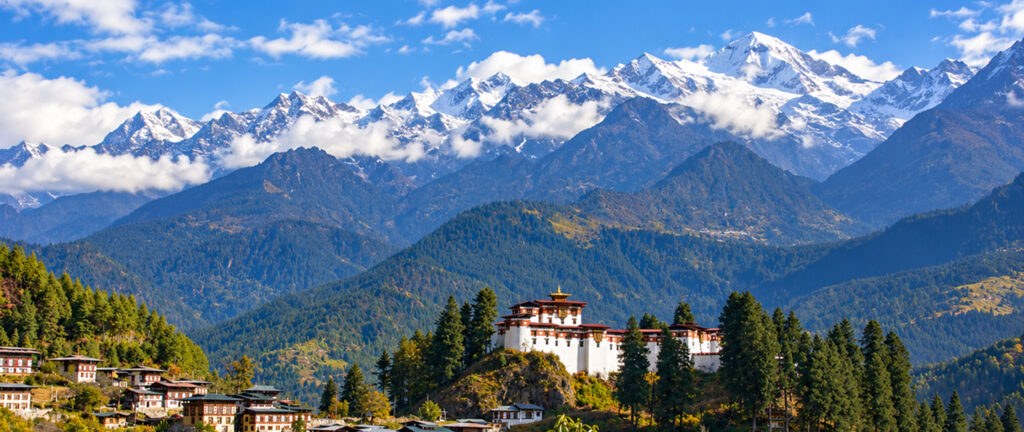
The first layer is the one that most visitors see: the magnificent Himalayan scenery, monasteries perched on cliffs, remarkable architecture, beautiful national dress and colourful religious festivals.
These are all genuine and important parts of Bhutan, and rightly attract visitors from around the world.
But beneath them lies another Bhutan, shaped by centuries of history, by the relationship between religion and government, by the influence of its monarchy and by the complicated business of maintaining the independence of a small country situated between two of the world’s greatest powers.
Then there are the extraordinary differences within Bhutan itself. The geography, languages, traditions, climate and ways of life of one region can be remarkably different from those of another. Bhutan is by no means a uniform society, however much its national identity may suggest otherwise.
Another layer concerns the role of Buddhism. Visitors are often told that Bhutan is a Buddhist country, but what does that actually mean? How does Buddhist philosophy influence the way people think, the way they live, their attitudes towards nature and their understanding of happiness? And how do those ideals coexist with the practical pressures of modern economic and social life?
Then there is the question of Bhutan’s monarchy. The country’s development, and particularly its remarkable transition to democracy, cannot be properly understood without appreciating the unusual role played by its Kings.
Even the much-discussed concept of Gross National Happiness deserves far more careful examination than the simplified descriptions often presented to tourists. It is not a claim that everybody in Bhutan is happy. It is a philosophical approach to development that raises some very interesting questions about what progress should mean.
Yet another layer is modern Bhutan, where young people are increasingly connected to the wider world, new technologies are changing expectations, and the country must confront questions about employment, migration, education, economic development and the preservation of its traditions.
How does a small country maintain its identity while embracing the opportunities and managing the pressures of the modern world?
These are not simple questions, and Bhutan does not always have simple answers.
That, to my mind, is precisely what makes it so interesting.
I have been fortunate to observe many of these changes personally, and sometimes to have been involved in them. I have known Bhutan in circumstances very different from those of today’s visitors, and I have watched its emergence into the modern world with affection, admiration, curiosity and, occasionally, concern.
I do not want Magical Kingdom Tours to give visitors a romanticised picture of Bhutan in which everything is wonderful and nothing is complicated. That would do the country an injustice.
I would rather help our visitors appreciate both its remarkable achievements and the challenges it faces.
Nor do I imagine that every visitor wants to spend an entire holiday discussing politics, economics or Buddhist philosophy! Some visitors come primarily for the scenery, the wildlife, the architecture or simply the experience of being somewhere different. All are equally welcome.
But for those who are curious, who enjoy asking questions and who want to look beneath the surface, I believe my long association with Bhutan can add a particularly rewarding dimension to their visit.
I hope that when you leave Bhutan, you will feel that you have peeled away at least a few of the layers of the onion.
And perhaps, like me, you will find yourself wanting to come back to discover the next ones.
Bhutan is widely admired for the importance it attaches to environmental protection, cultural preservation and a broader understanding of human wellbeing.
These achievements deserve recognition, but they should not be taken for granted. Like other countries, Bhutan faces difficult choices as it seeks to balance conservation, economic development and the aspirations of its people.
We believe tourism can make a positive contribution when it is approached with sensitivity and respect.
At Magical Kingdom Tours, we encourage visitors to appreciate the living traditions of Bhutan, respect its religious places and customs, support local communities and treat the country’s natural environment with care.
We also believe that thoughtful tourism should contribute to mutual understanding.
Visitors have much to learn from Bhutan, but Bhutanese people also benefit from meeting visitors who bring different experiences, perspectives and ideas.
The most rewarding travel is often a two-way exchange.
We hope that, by the end of your journey, you will have developed not only an affection for Bhutan, but also a deeper appreciation of the opportunities and challenges facing this remarkable country.